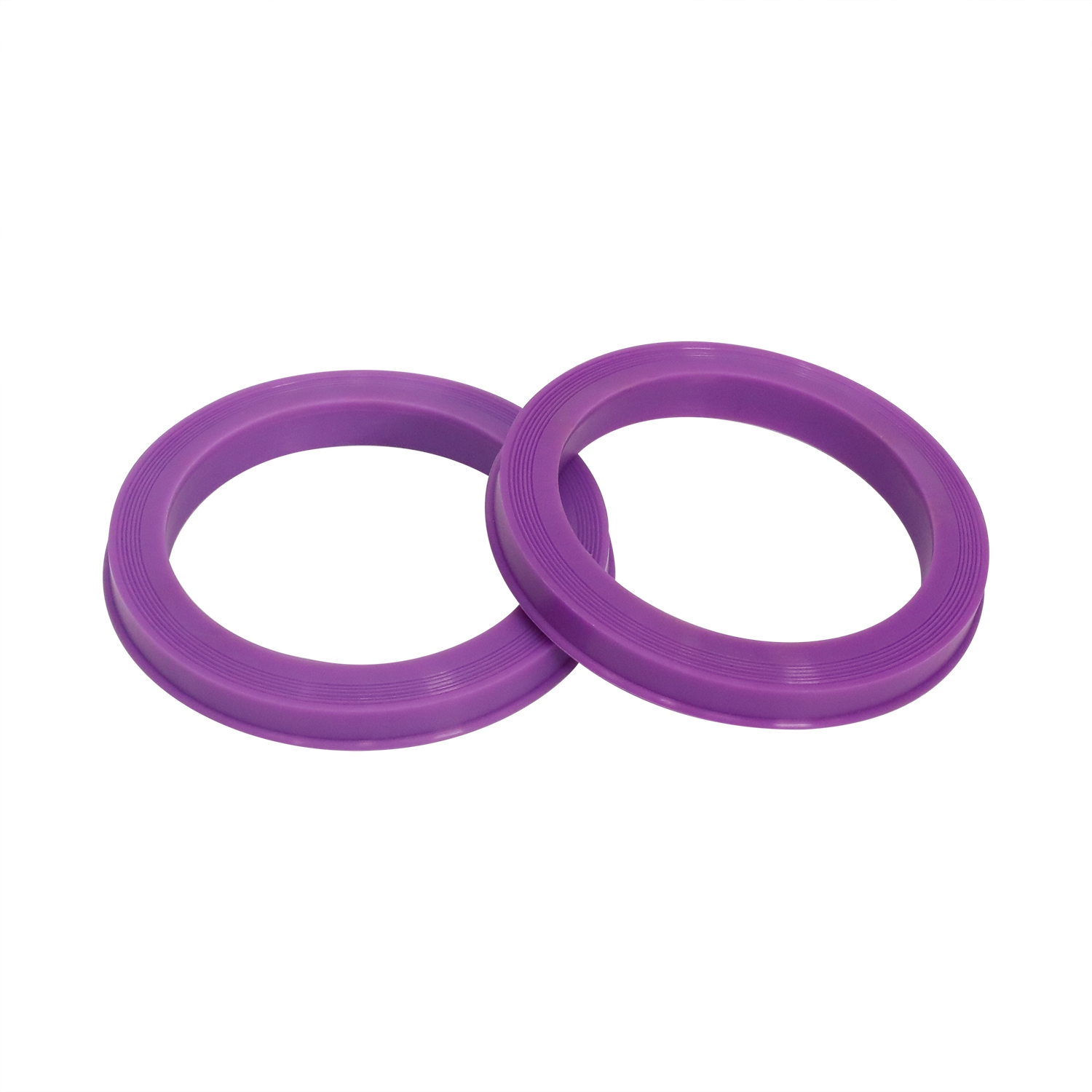
/ Hammer Union Seals
Abrasion-Resistant Polyurethane (TPU) Hammer Union Seals for Frac Sand
Our Oil-Resistant TPU Hammer Union Seals utilize a specialized Polyether-based TPU chemistry (rather than the cheaper Polyester-based TPU). This advanced formulation provides the abrasion resistance of urethane combined with the oil and water resistance of rubber. It is the modern solution for Oil-Based Muds (OBM) and complex frac fluids where standard TPU would fail.
Technical Specifications
- Working Pressure Ratings: 1,000 PSI to 22,500 PSI (depending on union rating)
- Durometer: 80-95 Shore A
Applications
- Hydraulic Fracking: High-pressure sand and proppant injection lines.
- Flowback Operations: Managing post-frac fluids and gases.
- Choke & Kill Manifolds: Safety-critical well control connections.
- Mud Lines: Circulating drilling mud systems.
- Acidizing & Cementing: Handling abrasive cement slurries and acid fluids.
Abrasion-Resistant Polyurethane (TPU) Hammer Union Seals for Frac Sand
1. Executive Summary: The Ultimate Defense Against “Washout”
In Hydraulic Fracturing operations, Proppant (Frac Sand) is the enemy of seal integrity. High-velocity sand slurries act like sandpaper, eroding standard Nitrile (NBR) seals within hours, leading to “washouts” and dangerous high-pressure leaks.
Our Abrasion-Resistant Polyurethane (TPU) Hammer Union Seals are engineered to survive where rubber fails. Manufactured from a custom-formulated, high-performance Cast Urethane or TPU, these seals offer 4x to 10x the abrasion resistance of standard elastomers. They are the mandatory specification for sand hogs, missile trailers, and any flowline handling heavy proppant loads.
2. Technical Deep Dive: TPU vs. Rubber in Erosion
The Physics of Erosion
When sand hits a soft NBR seal at 80 feet per second, it tears microscopic chunks off the surface (pitting).
-
The TPU Advantage: Polyurethane possesses exceptional “rebound resilience” and tear strength. Instead of tearing, the TPU surface absorbs the kinetic energy of the sand particle and bounces it off.
-
DIN Abrasion Standards: Our TPU compound consistently outperforms standard rubber in DIN 53516 abrasion testing, showing significantly less volume loss under abrasive load.
Rigid Anti-Extrusion Profile
Unlike rubber which behaves like a liquid under pressure, TPU is a semi-rigid thermoplastic.
-
Modulus: With a compressive modulus 3x higher than NBR, these seals bridge the extrusion gap naturally. They do not require a separate metal backup ring (in many designs) because the material itself acts as the anti-extrusion barrier.
3. Comprehensive Specifications
| Technical Parameter | Specification Data |
| Material Base | Thermoplastic Polyurethane (TPU) / Cast Urethane (CPU) |
| Primary Feature | Extreme Abrasion Resistance |
| Hardness | 95 Shore A (Hard/Rigid) |
| Tensile Strength | > 6,000 PSI (41 MPa) – Far stronger than NBR |
| Tear Strength | > 400 pli (ASTM D624) |
| Compatible Unions | Fig 1502, Fig 2002, Fig 1002 |
| Pressure Rating | 15,000 PSI (1,034 Bar) |
| Temperature | -30°F to +200°F (-34°C to +93°C) |
| Color | Red or Translucent Amber |
4. Ideal Applications (Frac Pad)
-
Sand Kings / Sand Hogs: Conveyor systems and blenders handling dry or wet sand.
-
Missile Trailers: The high-velocity discharge manifold facing the most severe erosion.
-
Kick-Out Lines: Where flow turbulence is highest.
5. Limitation Note
⚠️ ENGINEERING NOTE: TPU has a lower melting point than NBR/FKM. Maximum Service Temperature is 200°F (93°C). Do not use in high-temperature flowback or steam lines. For high heat + abrasion, please consult us for our specialty “High-Temp Urethane” grades.